
As an accountant, you’re often the first professional to spot when a business is in financial difficulty.
The challenge isn’t always identifying there’s a problem, it’s knowing which direction to point your client next. Should they fight to save the business? Or is it time to draw a line and minimise the damage?
Use the decision guide below as a practical framework for when it comes to conversations around business recuse vs closure.
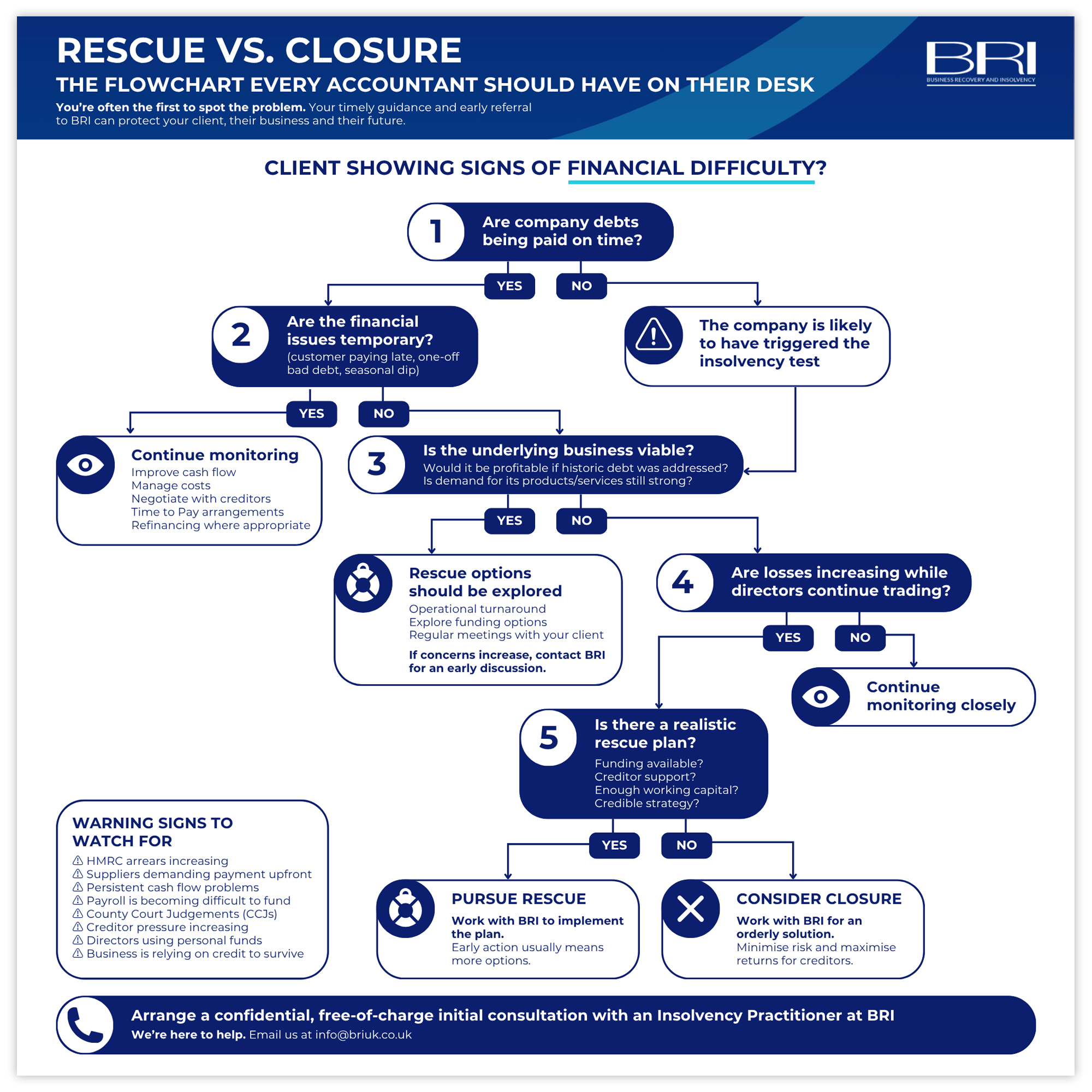
Business Rescue vs Closure
At BRI Business Recovery and Insolvency, we are a team of insolvency practitioners who have been supporting businesses and their professional advisers for many years. We pride ourselves on giving the right advice every time. Before making any recommendation, we take time to talk to you and your client to understand their circumstances and more importantly objectives.
When considering business rescue vs business closure, this is what we would recommend in many cases.
When Company Rescue Is the Better Outcome
Closure isn’t necessarily the only option. Acting early can create opportunities to stabilise the business, address underlying challenges, and explore whether recovery is possible.
Where there is a viable route forward, a company rescue process can:
- Protect jobs, suppliers, and valuable business relationships
- Give directors time and space to address financial pressures
- Restructure debts and improve cash flow where possible
- Preserve the value built up within the company
- Provide a chance for the business to return to a stronger position
In many cases, seeking professional advice at the first signs of financial distress can make the difference between a successful turnaround and an avoidable closure. The earlier rescue options are considered, the more choices directors may have available.
When Business Closure Is the Better Outcome
Closing a company is never an easy decision, but delaying it often makes matters worse.
Where rescue is no longer viable, an orderly insolvency process can:
- Protect directors from making matters worse
- Maximise returns to creditors where possible
- Reduce ongoing financial losses
- Allow directors to move on and start again
In many cases, acting sooner creates a better outcome than continuing to trade in the hope that circumstances improve.
The Accountant’s Role in Company Closure or Rescue
At BRI, we work closely with accountants to support their clients when financial difficulties arise. Clients rarely arrive asking whether they need an insolvency practitioner. Instead, they ask questions like:
- “Can we get through this?”
- “Should we keep trading?”
- “What happens if we can’t pay HMRC?”
- “Is it too late?”
Those early conversations matter.
By recognising the warning signs of insolvency and referring their clients to us before options become limited, accountants can help directors make informed decisions while protecting both the business and themselves.
The most successful outcomes almost always begin with early advice – not when every option has already disappeared.
Need a second opinion?
If you are an accountant (in-house or third party) and have a client showing signs of financial distress, we’re happy to provide an initial, free-of-charge confidential discussion. Even if formal insolvency isn’t required, an early conversation can help identify the most appropriate route whether that’s business rescue, restructuring, or an orderly closure.